Stanford University Departments of Physics & Applied Physics and the Ginzton Laboratory and QFARM Initiative
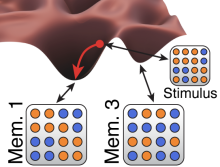
We have created the first quantum-optical associative memory, published in Science 394, 212 (2026)! We experimentally show that one can store and recall memories in a spin glass, which was long thought not possible. The exponentially many glassy minima—which cannot be used as memories under equilibrium recall—can now be turned into reliable memories under driven-dissipative cavity dynamics. By doing so, we achieve a storage capacity that exceeds the classical Hopfield limit by as much as seven-fold. A second key discovery is a polaronic “elasticity” that mimics the short-term synaptic plasticity inherent to biological systems. We show that this doubles memory capacity and points to future directions whereby our neural network can be trained using a naturally occurring synaptic plasticity. Read paper here.
Highlighted “In Science Journals.”